

the importance of sling angles
You Know That Split-Second Moment When The Crane Starts To Lift A Heavy Load And Everybody Holds Their Breath. There Is One Way To Make That Moment Less Stressful And More Confident, And Then Watch How The Crane Lifts The Load Safely. And That Way Is To Ensure The Best Possible Sling Angles For Your Load.
It May Sound Like A Small Detail, But It Can Make A Big Difference. A Few Degrees Between The Sling Legs And The Load Could Mean The Difference Between The Weight The Slings Are Actually Carrying And Whether Your Lift Goes Smoothly Or Dangerously Wrong.
Sling Leg Weight
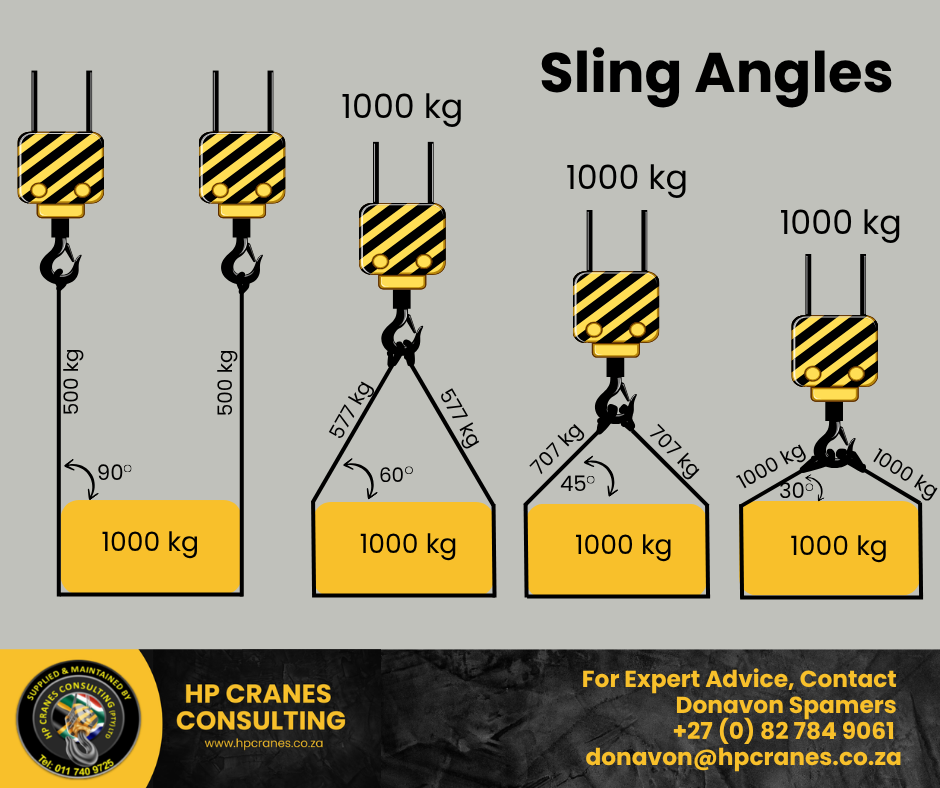
When A Sling Hangs Straight Up And Down, Each Sling Leg Carries Only Half Of The Load Directly Beneath It. But When You Spread The Sling Legs Outwards, The Angle Between The Sling And The Load Gets Smaller, Causing Each Leg To Be Under More Strain.
It’s Like When You Have To Carry A Bucket Of Water In Your Hand. When The Bucket Is Closer To Your Body, It’s Easier To Carry Than When You Carry The Bucket With Your Arm Stretched Out. The Same Happens With Slings – The Wider The Angle The Bigger The Tension.
When The Sling Is At A 60° Angle From The Load, Each Sling Leg Carries About 15% More Of The Load. When You Stretch The Angle So That The Sling Is At 45° From The Load, The Load On The Sling Legs Becomes 40%. When The Angle Drops To 30°, The Load Doubles On Each Sling. But The Stress Doesn’t Just Affect The Sling, It Transfers Through The Hooks, Shackles And The Crane Itself.
Calculation
Here’s A Formula To Help You Estimate The Load On The Sling Legs:
Tension Per
Sling Leg = (Load  By Number Of Slings) Sin(Angle From Horizontal)
Example:
On A 1000kg Load With 2 Slings, Each Sling Makes A 45° Angle From Horizontal.
Tension = (1000
2) Sin(45°)
Since Sin (45°) = 0.707,
Tension = 500 0.707 = 707Kg Per Sling.
So, Even When Your Total Load Is 1000kg, Each Sling Is Carrying Roughly 707
kg, Not 500Kg As You Might Assume. The Smaller The Angle, The Bigger The Number Each Sling Has To Lift.
Tip: Try To Keep The Sling Angle Above 45°.
Key Takeaways:
· The Smaller The Sling Angle, The Higher The Tension On Each Leg.
· Try To Keep The Sling Angles Above 45°.
· Make Sure That The Slings Can Handle The Weight.
(Coming Soon: Blog Post For A Single Angle Load Factor Chart.)